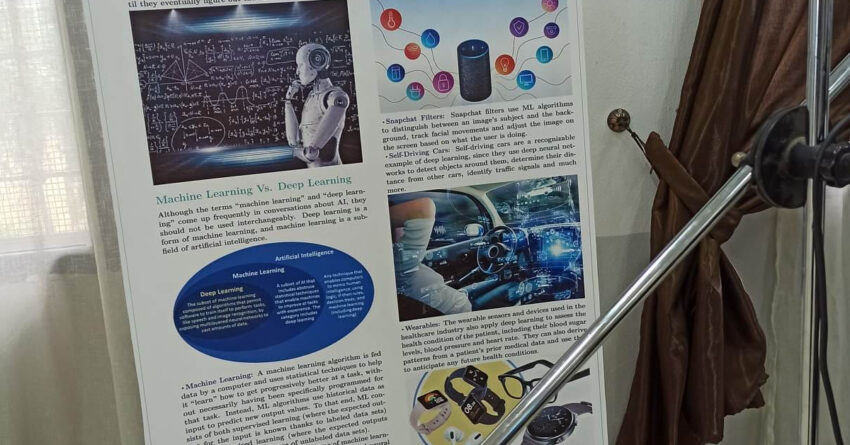
On 16 May 2023, I presented “Exploring the Possibilities of Using Artificial Intelligence and ECG for Identifying Patients” at the AI in the Medical Field event, organized by the House of AI at Badji Mokhtar – Annaba University. The event was held on the occasion of Students’ Day and brought together professors, researchers, PhD candidates, and students from a wide range of disciplines, a mix that shaped how I approached the talk from the outset. Radio Annaba also covered the event, extending the discussion to a broader public audience.
With an audience that spanned engineering, medicine, and beyond, the goal was to present technically grounded research in a way that was meaningful to everyone in the room, not just signal processing specialists.
Introduction to Biometrics
The talk opened with the basics: what biometrics is, why it matters, and how it works. Biometric systems identify or verify individuals based on measurable physical or behavioural characteristics. The most familiar examples (fingerprints, facial recognition, iris scans, etc) are now part of everyday life, embedded in our phones, border controls, and banking applications.
But familiarity brings vulnerability. These modalities are external and observable, which makes them susceptible to forgery, spoofing, and theft. A fingerprint can be lifted from a surface, a face can be reproduced from a photograph. The question motivating my research is whether there are biometric signals that are harder to access, harder to fake, and still rich enough in individual-specific information to serve as reliable identifiers.
ECG as a Biometric Signal
The electrocardiogram (ECG) records the electrical activity of the heart over time. Each heartbeat produces a characteristic waveform, commonly described in terms of its P wave, QRS complex, and T wave, that reflects the timing and conduction of electrical impulses through cardiac tissue.
What makes the ECG interesting from a biometric standpoint is that this waveform is not purely a function of heart rate or health status. Its morphology is also shaped by the physical structure of the heart and surrounding tissue, which varies from person to person. This means the ECG carries a kind of embedded physiological signature, one that is internal, continuous, and extremely difficult to reproduce without access to the individual’s own body.
This is the core argument for ECG as a biometric modality: it is a hidden signal that can be acquired non-invasively, and it encodes identity in a way that no external observation can easily replicate.
Deep Learning for ECG Classification
Having established why ECG is a promising biometric modality, the talk moved into how it is actually processed and classified. This required bridging the gap between signal processing and machine learning for an audience that was not necessarily familiar with either.
Deep learning, at its simplest, is a class of machine learning methods that learn hierarchical representations from data, rather than relying on manually engineered features. For ECG biometrics, this is particularly relevant: the discriminative information in a cardiac signal is subtle and distributed across the waveform, making handcrafted feature design both difficult and brittle.
I presented how deep neural networks, in particular convolutional and recurrent architectures, can be trained to extract and learn identity-relevant patterns directly from preprocessed ECG segments. The pipeline involves denoising the raw signal, detecting and segmenting individual heartbeats, and feeding standardised windows into a classifier trained to associate waveform patterns with specific individuals.
At the time of the talk, I had already obtained and presented experimental results from conference work, demonstrating that this approach achieves reliable identification across subjects.
ECG Biometrics in Healthcare
The most substantive discussion of the day centred on what this technology could mean in a clinical context. Patient misidentification is a recognised problem in healthcare systems worldwide: wrong-patient errors in medication administration, sample labelling, and record access carry real consequences for patient safety.
ECG-based identification offers a compelling fit for healthcare environments precisely because ECG monitoring is already standard practice in many clinical settings. A patient connected to a cardiac monitor is already generating the signal needed for biometric identification, no additional hardware, no additional procedure. The identification step could, in principle, be integrated transparently into existing monitoring workflows.
This led to the most engaged part of the audience discussion: the practical and ethical questions that any deployment of physiological data for identification purposes must confront. How should cardiac data be stored and protected? Who controls access? How do systems handle patients with cardiac conditions that alter waveform morphology? These are not purely technical questions, and the diversity of the audience made for a genuinely multidisciplinary exchange.
Reflections
Presenting to a mixed audience is a different kind of challenge from presenting at a technical conference. The goal is not to simplify to the point of inaccuracy, but to find the level of abstraction at which the core ideas remain precise while becoming accessible. The questions that followed (on hospital integration, data privacy, and real-world signal quality) were evidence that the material had landed across the room, not just with the engineers.
The engagement from professors and researchers across disciplines, and the broader reach afforded by Radio Annaba’s coverage, made this one of the more rewarding public-facing events I have participated in.
Resources
Acknowledgements
My thanks to the House of AI for the invitation, to all participants for their engagement, and to Radio Annaba for broadcasting the event to the wider community.